Surprising Secrets of Angular Animation Overflow Hidden Revealed Click Here to Uncover
Have a question about this project? Sign up for a free account to open an issue and contact its maintainers and the community.
By clicking “Sign up for ”, you agree to our terms of service and privacy statement. We’ll occasionally send you account related emails.
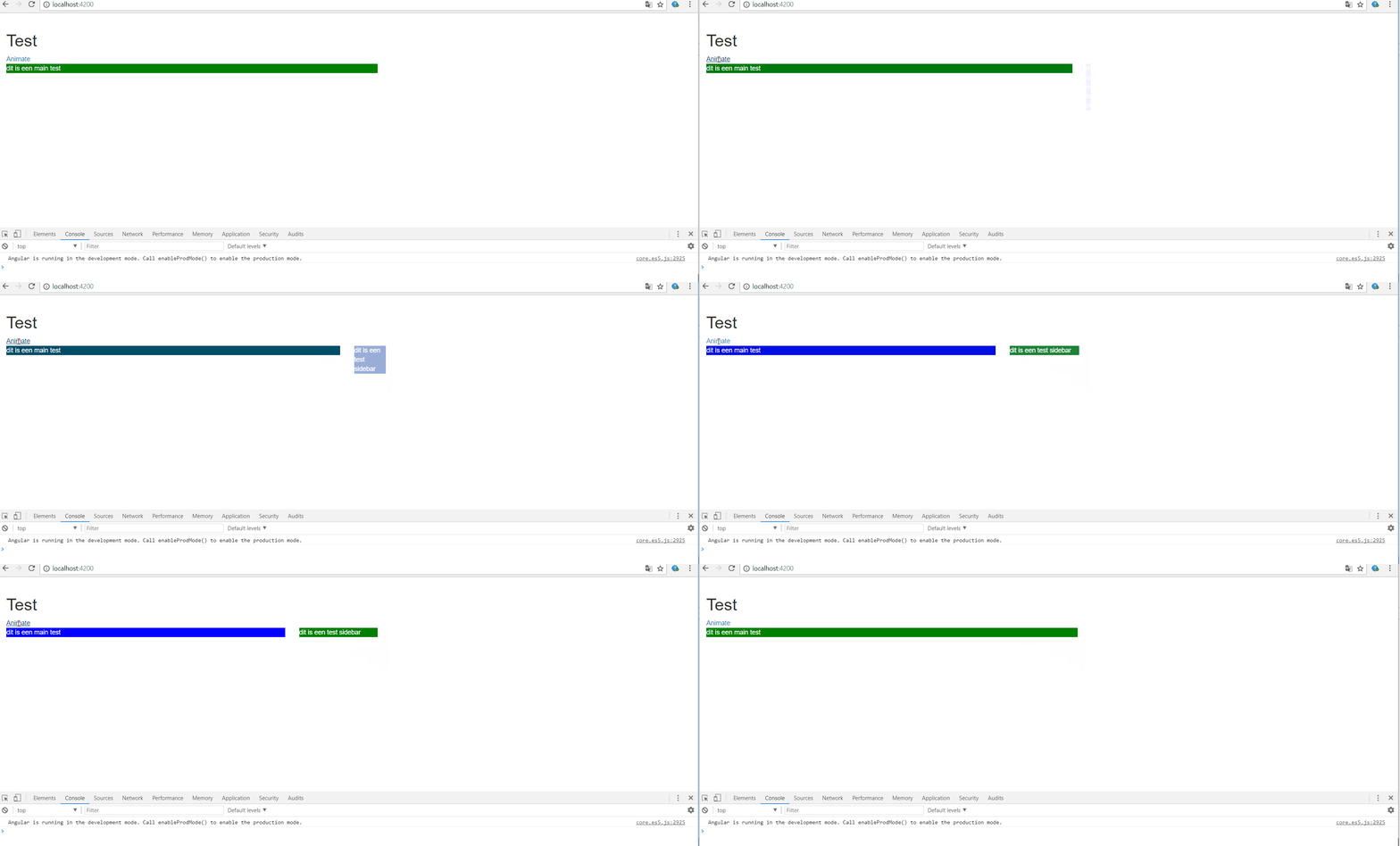
For me to remove the overflow hidden, I would have to set the style manually with the same delay as the animation.
React Native Collapsible Headers
@dionatan-g sorry, I do not believe this is a false positive, let me explain why, the fact is that your code is actually trying to animate the overflow property, as you can see from the keyframes that gets generated for the player:
, this is because the lack of an overflow in the first state just means that for the animation the current value of that property is taken from the dom element itself, as you can see here:
I would also like to add that I believe this is the desired functionality, for example from my first screenshot you can see that I added a background color to the animation, this is my animation code:
The Best Cool Javascript Animations To Use On Your Website
And this allows us to be able to transition from/to the red background without the need to specify that (or being forced to manually add
Anyways what is happening with the background color is precisely the same as it is happening with your overflow, so I do believe that the current implementation is correct in providing the warning since for all intents and purposes you are actually trying to transition from
@dario-piotrowicz the point is taken; but could you please share the right way to deal with such a non-animatable properties that have to be set in the end of transition?
Pokémon Cross Guard
I'd just use states one in the initial state with the hidden overflow and one in the end start with a overflow visible.
The alternative I can think of is using animation callbacks so that when the transition ends you can set the style of your element in whichever way you prefer.
I've a bit torn on this one, on one hand I understand that using callbacks is going to create more unnecessary code, on the other I think that it's sort of the cleanest thing since in the animation code you are practically indeed trying to animate a property that is not animatable...
How To Build A Social Networking Site With Vuejs (facebook Clone)
Yeah I think that at the very least we should provide a way so that developers can suppress the warning so that in any case they'd be able to decide what they prefer
Though I guess animation callback is way too much: imagine you have one prepared animation and tens of components using it - you'd have to insert such a callback so many times just to satisfy the questionable approach.
I was hoping for something like being able to add/remove a class on state transition but it appears there's no way as well.
Edge & Ie Not Respecting Overflow Y In Angular Animation
, if it helps I was already planning to soon look into some way to make the warning configurable so that users can opt out of it.
I apologize for the ghost @dario-piotrowicz , I remember I read your reply at the time and completely forgot to answer it.
In the meantime, since the warning was introduced and now, I had a few devs (4 to be precise) questioning me about those warnings and how they could fix it.

Break Your Bsd Kernel
So everytime I had to explain that there is nothing wrong, is just a warning that was introduced because of the non-animatable properties etc.
Even tho I didn't see many issues or upvotes on this one, I think there's a lot of people that either think they are doing something completely wrong and just stoped trying to use animation or they just opened issues at the component library repos, not in Angular's repo.
Imo, this warning should be the other way around, until we don't have a clear way to refactor, it should be disabled. When we actually have an alternative that is pratical, then the warning can be enabled again.
Posts Tagged With
But disabling it completely would remove any benefit of it (thus not helping in cases like issue 27577), I think it could be enough to keep it but provide a very easy way to disable it (and mention that way in the warning, something like if you don't want to see this warning again do ...) , what do you think?
@dionatan-g I've acutally got a flag to disable the warning working on a local branch (basically there you can put the flag in the BrowserAnimationsModule to disable the warnings globally), I wanted to open a PR but haven't found the time (I still need to add unit tests for it), at the latest I'll open the PR this weekend
Regarding the styles I have some ideas/thoughts but I need to play with it to be sure....anyways yeah if you want create a new issue so we can keep things separate
What's New In Samba ?
@dionatan-g, @strigefleur If you want please have a look at the PR, especially the unit tests to see how I implemented the disabling and if that looks good for your use cases
I believe it still takes some efforts to solve the primary case we mentioned earlier (as to have some special way to define non-animatable styles within transition scope) but currently it completely satisfies the needs.

You signed in with another tab or window. Reload to refresh your session. You signed out in another tab or window. Reload to refresh your session.Have a question about this project? Sign up for a free account to open an issue and contact its maintainers and the community.
The Visual Artists' News Sheet
By clicking “Sign up for ”, you agree to our terms of service and privacy statement. We’ll occasionally send you account related emails.
Are preparation styles to be applied for the duration of the transition but are not set up to be animated. Still I get a warning about
Calls above are specific about which attributes are to be animated, so they are not trying to animate towards all the attributes of the destination state.
Motion Grafics Part2 By Steven Roesbeke
Am I wrong in my understanding of how transitions in Angular work or is the compiler being unnecessarily critic in the new version?
@diegovilar it is not that the code is being more critic, I added that functionality to provide a better experience for developers so that if they see that something is not being animated then they can easily identify what is going wrong.
So regardless on the warnings, if your code worked fine prior to Angular 14, it will work exactly the same in 14, as the only difference is the warning being shown (note that it is also a dev only warning, there is no effect in production at all).
Digitalisierte Sammlungen Der Staatsbibliothek Zu Berlin Werkansicht: A Naturalist In North Celebes: A Narrative Of Travels In Minahassa, The Sangir And Talaut Islands, With Notices Of The Fauna, Flora And Ethnology Of
Being called on it's own or being part of an animation (and personally I am not sure there should be such distinction), it could be tricky to implement but I could give it a shot if needed
Should only be used as part of an animation implementation, and not in order to set non-animation related styles to elements, for that trigger callbacks could be used instead (it would be more verbose I know
Thanks for the detailed response, @dario-piotrowicz. @diegovilar I'm going to close this as working as intended, but if you have suggestions, feel free to continue to comment here. We welcome the improvement ideas. Thanks for reporting this.
Listen To Coding Blocks Podcast
@diegovilar it is not that the code is being more critic, I added that functionality to provide a better experience for developers so that if they see that something is not being animated then they can easily identify what is going wrong. So regardless on the warnings, if your code worked fine prior to Angular 14, it will work exactly the same in 14, as the only difference is the warning being shown (note that it is also a dev only warning, there is no effect in production at all). Anyways the thing is that in when the style function is evaluated it is in the context of animations, there is no distinction between style being called on it's own or being part of an animation (and personally I am not sure there should be such distinction), it could be tricky to implement but I could give it a shot if needed 🙂 One very simple alternative would be to add an optional options parameter to the style function, something like ignoreNonAnimatableProps to suppress the warning, or something similar 🤔
@dario-piotrowicz I see how tricky it could be to improve the code to detect if the developer is really trying to animate not animatable properties. Probably unnecessary too.
The new warnings do provide a better experience for the developers, as was your intention, but when warnings keep being issued even when a developer analyzed them and decided that they are not applicable, they end up obfuscating newer warnings and those might slip by, thus worsening the experience. Your idea of allowing the developer to explicitly disable the warnings for a
Float Labels With Css
Call sounds great. They would be warned, would analyze the code and either fix it or disable the warnings if there is nothing to fix, kinda like locally disabling an
Belum ada Komentar untuk "Surprising Secrets of Angular Animation Overflow Hidden Revealed Click Here to Uncover"
Posting Komentar